 English
 中文简体
中文简体Industry News

Cabinet-type battery production looks, from the outside, like a straightforward scaling exercise — take a wall-mounted cell configuration, put more of it in a bigger enclosure. Production engineers at an Energy Storage Cabinet Manufacturer describe it differently: cabinet-scale output changes how the battery management system has to behave, not just how much capacity sits inside the housing.
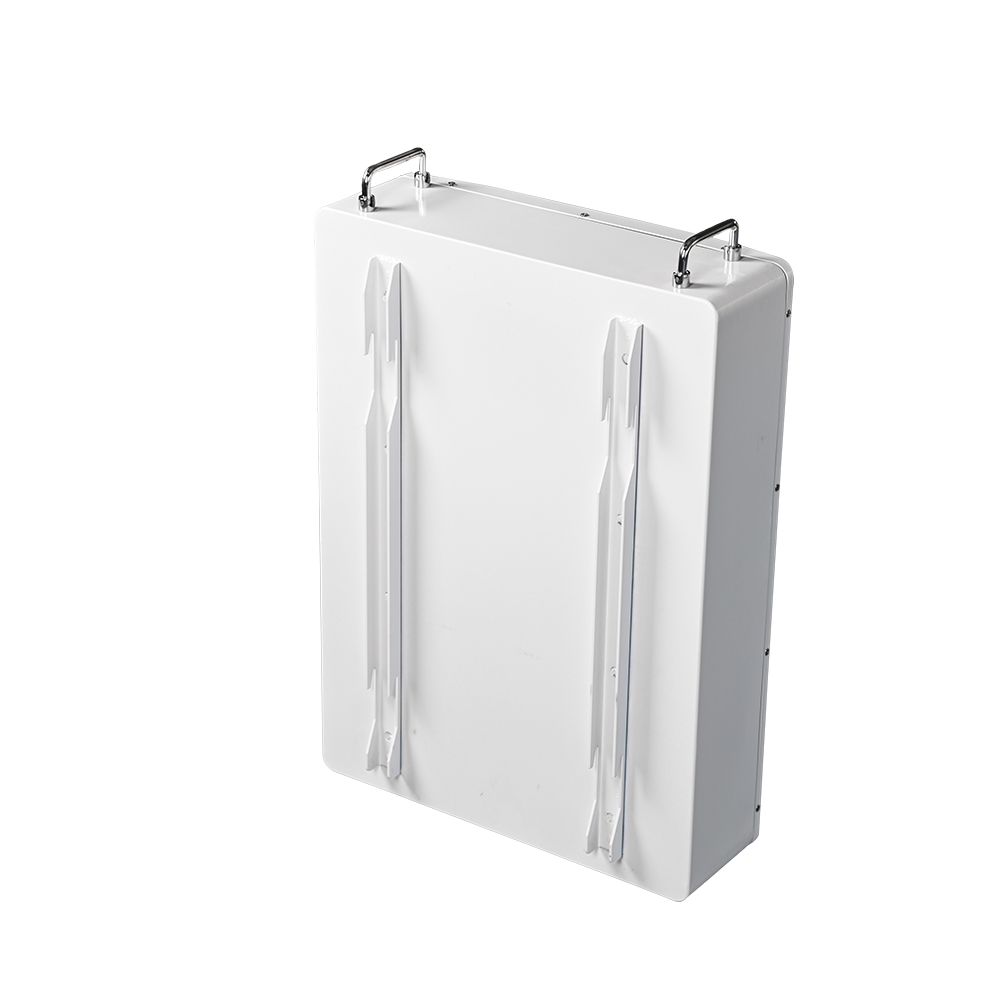
A wall-mounted unit manages a relatively small cell string, while a cabinet-type unit manages many more cells in series and parallel, which multiplies the opportunities for individual cells to drift out of balance over repeated cycles. An Energy Storage Cabinet Manufacturer building at this scale needs BMS firmware capable of monitoring and correcting imbalance across the full string in real time, not firmware adapted from a smaller wall-mounted design, because imbalance that goes uncorrected at cabinet scale degrades usable capacity considerably faster than the same imbalance would at wall-mounted scale.
A stacked high-voltage battery system and a cabinet-type unit both target larger capacity than wall-mounted products, but they solve different installation constraints. Stacked configurations let installers add modules incrementally as demand grows, while cabinet units are typically sized and specified once at installation. Buyers evaluating an Energy Storage Cabinet Manufacturer for a project with uncertain future capacity needs should weigh whether incremental stacking or fixed-cabinet sizing better matches how the site's demand is expected to change over the following several years.
|
Build Type |
Cabinet-Type Unit |
Stacked High-Voltage Unit |
|
Capacity expansion |
Fixed at installation |
Incremental, module by module |
|
BMS complexity |
High, full-string balancing required |
Distributed across modules |
|
Typical deployment |
Fixed-capacity residential or small commercial |
Sites with growing storage needs |
|
Footprint flexibility |
Lower |
Higher |
Manufacturers that handle cell selection, BMS design, and PACK assembly under one roof can adjust one variable without waiting on an external supplier's revision cycle, which matters directly for cabinet-type lithium iron phosphate battery projects where BMS firmware often needs several rounds of tuning against real cell behavior before it ships. An OEM Energy Storage Cabinet Manufacturer program run across separate vendors for cells, BMS, and enclosure typically takes longer to stabilize during the qualification phase, since each firmware revision has to pass through a different company's release schedule.
A cabinet unit destined for outdoor installation in a hot climate faces thermal stress that a lab-standard cycle test at room temperature does not capture. Manufacturers with an in-house testing lab can run cycle tests at the temperature range matching a buyer's actual deployment region, rather than relying solely on standardized lab conditions that may not reflect field performance. Buyers sourcing an Energy Storage Cabinet Manufacturer for deployment in high-ambient-temperature regions should request test data at conditions matching the installation site, since standard-condition cycle-life figures can overstate real-world performance in hotter climates.
At low production volumes, cell-level defects tend to surface during initial burn-in testing. At the volumes typical of a facility producing over 100,000 units annually, enclosure fit, connector wear, and cable routing defects become more statistically visible because they accumulate across a much larger sample before appearing as a pattern. An Energy Storage Cabinet Manufacturer operating at that scale generally builds inspection checkpoints around these higher-volume failure modes specifically, rather than relying only on the cell-level testing protocols that catch defects at a smaller production scale.
Get to know quickly
We are a professional lithium iron phosphate battery, solar energy storage system, industrial and commercial energy storage system manufacturer.
 +86-133 3592 3377
 +86-4008833583
 Email: [email protected]

Copyright © Zhejiang Paichen Energy Storage Group Co., Ltd All Rights Reserved.

Battery Energy System Manufacturer