 English
 中文简体
中文简体Industry News

An Emergency Backup Solar Power System becomes particularly relevant when a solar installation needs to do more than generate electricity during normal operation. Homes, small businesses, communication equipment, and other facilities may have several loads that cannot simply stop when the grid goes down. In these applications, solar generation, battery storage, power conversion, and load management have to work as part of the same electrical system.
Solar panels alone do not provide the same function as backup power. Their output changes with sunlight, while an outage can occur at any time of day. An Emergency Backup Solar Power System therefore needs a storage component capable of holding available solar energy and supplying electricity when the normal grid connection is unavailable. The battery becomes an active part of the power architecture rather than an additional component added after the solar system has been designed.
Battery configuration is closely related to the type of load being protected. A household may prioritize lighting, refrigeration, communications, or selected appliances, while a commercial site may need to keep security equipment, networking systems, control equipment, or other essential loads operating. An Emergency Backup Solar Power System designed around these different requirements cannot rely on a single standard battery configuration for every application.
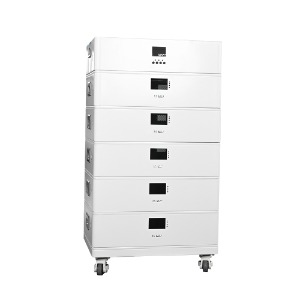
Paichen is a manufacturer of lithium iron phosphate batteries, home energy storage systems, and industrial and commercial energy storage systems. The company states that its R&D and manufacturing capabilities cover BMS, PACK design, and electrical system design, allowing energy storage products to be developed and produced around different system requirements.
The battery management system is another important part of an Emergency Backup Solar Power System. A BMS monitors battery conditions such as voltage and temperature and manages charging and discharging according to the battery configuration. Paichen's wall-mounted lithium iron phosphate battery, for example, uses an intelligent BMS and provides RS485 and CAN communication interfaces for connection with compatible inverter systems.
For larger installations, the relationship between storage capacity and power output becomes more significant. Paichen's industrial and commercial energy storage products include systems designed for grid-connected and off-grid operation, with some configurations specifically described for emergency backup power when the grid fails. An Emergency Backup Solar Power System used in these environments may therefore form part of a broader energy management arrangement rather than functioning as a standalone battery.
System enclosure and thermal management also become relevant as storage capacity increases. Battery modules generate heat during charging and discharging, so the internal arrangement, cooling method, monitoring system, and protection design all influence how an energy storage unit operates over time. Paichen offers both air-cooled and liquid-cooled energy storage configurations for different system scales and applications.
The practical design of an Emergency Backup Solar Power System also depends on how the loads are connected. Keeping every circuit active during an outage can require substantially more storage than maintaining only critical circuits. Defining essential loads in advance can therefore affect battery capacity, inverter sizing, and the expected backup duration without changing the solar panels themselves.
Paichen operates as a direct manufacturer of lithium iron phosphate batteries and solar energy storage systems and states that it provides customized development based on customer drawings or samples. The company also reports an annual production capacity exceeding 100,000 units and maintains its own testing laboratory and inspection equipment.
As solar installations continue to incorporate storage, an Emergency Backup Solar Power System is increasingly shaped by the relationship between generation, battery capacity, BMS control, power conversion, and the loads that need to remain active. Treating these elements as one system gives manufacturers more flexibility when developing backup solutions for residential, commercial, and industrial applications. For Paichen, its combination of battery production, energy storage development, BMS technology, and electrical system design provides the manufacturing foundation for these integrated applications.
Get to know quickly
We are a professional lithium iron phosphate battery, solar energy storage system, industrial and commercial energy storage system manufacturer.
 +86-133 3592 3377
 +86-4008833583
 Email: [email protected]

Copyright © Zhejiang Paichen Energy Storage Group Co., Ltd All Rights Reserved.

Battery Energy System Manufacturer