 English
 中文简体
中文简体Industry News
Home / News / Industry News / Residential Solar Battery Storage Systems Adapt to Household Energy Use

Solar panels can generate electricity during daylight hours, but household electricity demand does not necessarily follow the same schedule. This difference has made Residential Solar Battery Storage Systems an increasingly important part of residential energy system design. Instead of considering solar generation and battery storage as separate products, system developers are increasingly looking at how generation, storage, household loads, and inverter communication work together across the day.
A typical home can have different electricity requirements throughout the day. Solar generation may be strongest around midday, while household consumption can increase during the morning and evening. Without storage, the timing of generation and consumption can therefore limit how much of the generated electricity is used directly within the home.
This is where Residential Solar Battery Storage Systems provide a different operating structure. Electricity generated by a photovoltaic system can be stored and later made available when household demand increases. Paichen describes its home energy storage category as systems that can store energy from renewable sources such as solar and wind for later use.
When developing a residential storage system, capacity is an important consideration, but it is not the only one. Household load patterns, inverter compatibility, installation space, battery voltage, discharge requirements, and the possibility of future expansion can all influence the configuration.
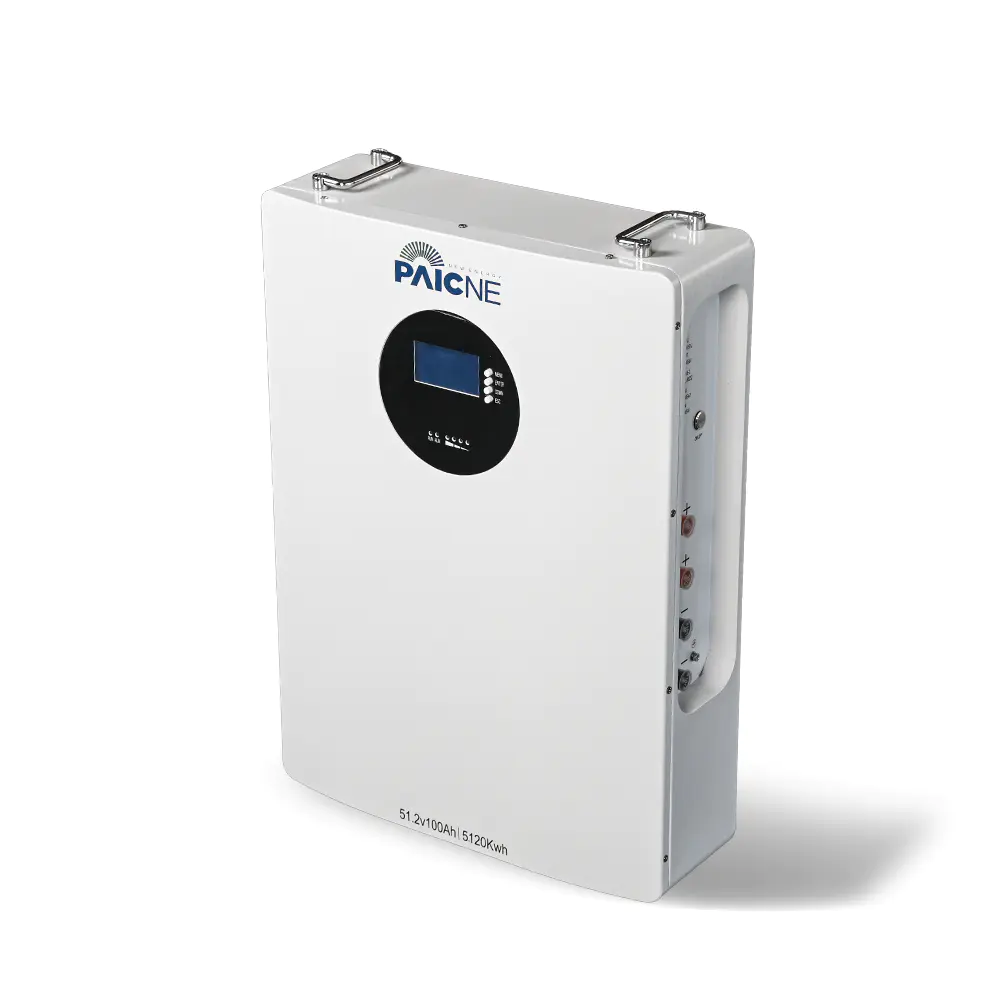
Paichen's wall-mounted lithium iron phosphate battery uses a modular design and can support parallel connection of up to 32 battery modules. It also includes RS485 and CAN communication interfaces for connection with mainstream inverter brands.
This modular approach allows Residential Solar Battery Storage Systems to be configured around different household requirements instead of assuming that every home needs the same battery arrangement.
Residential energy storage equipment is installed in environments where available space can be limited. Unlike large industrial facilities, homes may have dedicated utility areas, garages, storage rooms, or exterior installation locations with different spatial constraints.
Wall-mounted battery structures can address one aspect of this challenge by using vertical installation space. Paichen's wall-mounted system is designed around a compact modular structure and is intended for residential photovoltaic energy storage applications.
For B2B system developers, this means enclosure dimensions, mounting method, module arrangement, and cable connections need to be considered together with electrical specifications.
Modern residential storage is increasingly connected to other electrical equipment rather than operating as an isolated battery. The inverter manages energy conversion between the battery, solar generation, and household electrical system, making communication between components important.
RS485 and CAN interfaces can allow battery information to be exchanged with compatible inverter systems. Paichen's wall-mounted lithium iron phosphate battery also includes an LCD display and BMS software for monitoring battery status and performance parameters.
This means the development of Residential Solar Battery Storage Systems involves both physical energy storage and information management. Battery state, charging and discharging conditions, and system operating status can all become part of the wider energy management process.
Households do not have identical energy consumption patterns, so a single battery configuration cannot necessarily suit every installation. Some homes may require a relatively compact storage system, while others may need greater capacity or future expansion.
Paichen also offers stacked high-voltage lithium iron phosphate batteries with a voltage range of 102.4V to 768V and support for expandable configurations. These different approaches demonstrate how residential storage architecture can vary according to capacity, voltage, space, and system requirements.
For equipment manufacturers and B2B buyers, this creates a need to evaluate the complete system rather than focusing on battery capacity alone.
The development of Residential Solar Battery Storage Systems reflects a broader shift in how household energy equipment is designed. Solar generation, battery storage, inverter communication, installation space, and household demand all influence the final configuration.
For manufacturers and system integrators, the challenge is therefore not simply to provide a battery with sufficient capacity. The storage system needs to correspond with the household's electricity profile and integrate with the rest of the photovoltaic system. Modular battery structures, BMS monitoring, communication interfaces, and different installation formats provide several ways to adapt the system to these requirements.
As residential solar installations become more integrated, battery storage is increasingly being treated as part of the home's overall energy architecture. The focus is shifting from a standalone battery toward a coordinated system in which generation, storage, conversion, monitoring, and household consumption work together.
Get to know quickly
We are a professional lithium iron phosphate battery, solar energy storage system, industrial and commercial energy storage system manufacturer.
 +86-133 3592 3377
 +86-4008833583
 Email: [email protected]

Copyright © Zhejiang Paichen Energy Storage Group Co., Ltd All Rights Reserved.

Battery Energy System Manufacturer