 English
 中文简体
中文简体Industry News

Home energy storage equipment is becoming easier to integrate into residential spaces as battery systems move away from bulky floor-standing layouts. A Wall Mount Lifepo4 Battery places the storage unit against the wall while using a modular structure that can be expanded according to the required household capacity. Paichen's wall-mounted lithium iron phosphate battery is designed for residential energy storage and can be connected with solar photovoltaic systems.
A wall-mounted battery uses vertical space rather than requiring the entire battery enclosure to occupy floor area. This can be useful in homes where equipment rooms, garages, utility areas, or other installation spaces have limited floor space.
The structure also affects how the battery is arranged within a home energy system. Instead of treating the battery as a large independent cabinet, the wall-mounted format keeps the storage unit relatively compact while providing access to the electrical and communication interfaces.
Paichen describes its product as having a compact modular design. The battery modules can be configured according to actual household requirements, with up to 32 battery modules connected in parallel.
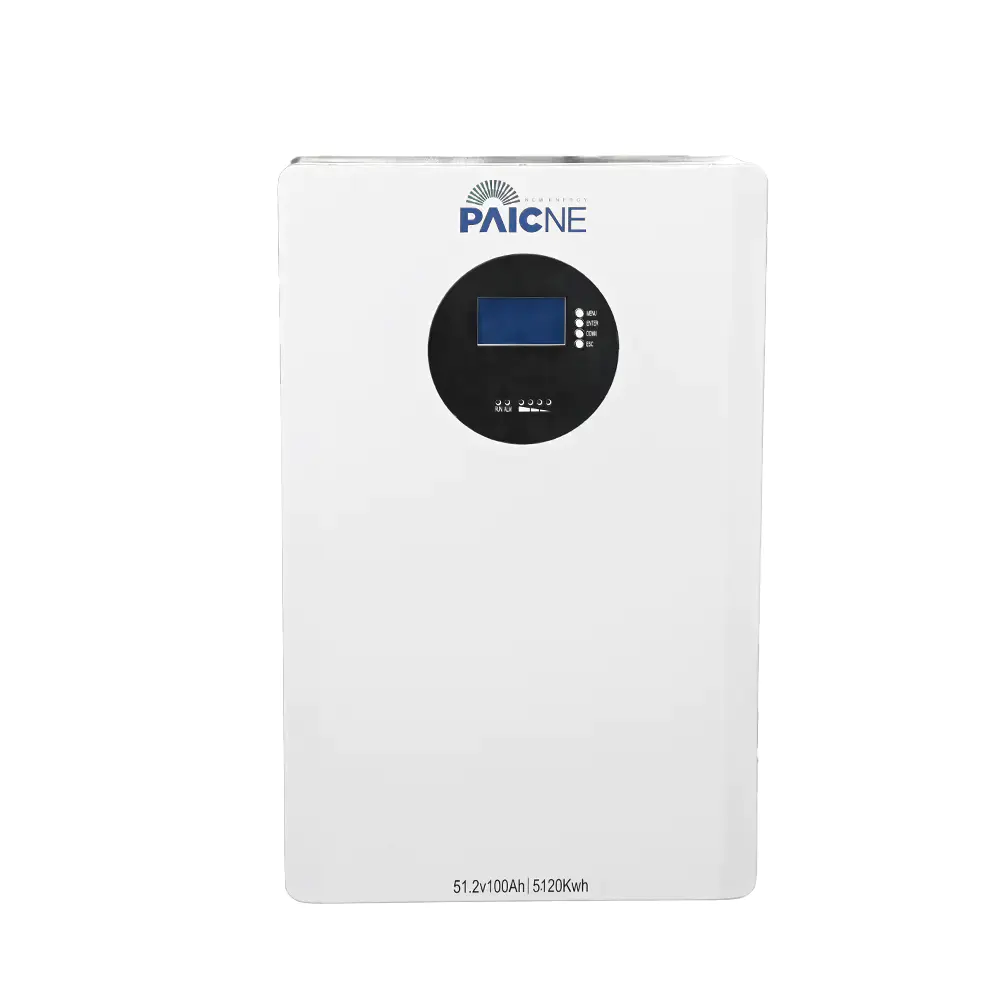
The modular design is one of the more important characteristics of a Wall Mount Lifepo4 Battery. Household electricity consumption varies significantly between properties, so a fixed battery configuration does not necessarily suit every installation.
A modular structure provides a way to increase the storage configuration without changing the basic concept of the battery system. Paichen states that its wall-mounted battery can be expanded through parallel connection of battery modules, allowing the system to cover different household energy storage requirements.
This arrangement also affects maintenance. Individual modules can be managed within the larger battery configuration rather than treating the entire storage system as one indivisible unit.
A Wall Mount Lifepo4 Battery is not an isolated power source. It needs to communicate with other equipment in the home energy storage system, particularly the inverter responsible for converting and managing electrical power.
Paichen's battery includes RS485 and CAN communication interfaces and is described as supporting mainstream inverter brands. These interfaces provide a communication path for monitoring battery conditions and managing the storage system.
This communication function becomes particularly useful when battery status needs to be monitored together with charging and discharging activity. Rather than relying only on the battery's physical indicators, the connected system can exchange operating information through its communication interface.
The battery management system is another important part of the product architecture. Paichen's wall-mounted battery includes intelligent BMS software together with an LCD display for monitoring battery status and performance parameters.
The display can provide information such as remaining capacity and charge/discharge status, while the BMS manages battery operating conditions.
For a Wall Mount Lifepo4 Battery, these functions are particularly relevant because the battery is intended to operate as part of a complete residential energy system rather than as a standalone rechargeable battery.
The lithium iron phosphate chemistry also gives the system a different operating profile from traditional lead-acid storage. Paichen states that the product is designed for a service life of 15–20 years and identifies higher cycle life and lower self-discharge as characteristics of its lithium iron phosphate battery technology.
A Wall Mount Lifepo4 Battery can be integrated into household solar energy storage, where electricity generated by photovoltaic equipment can be stored for later use. The same battery can also provide stored energy for household backup applications.
Paichen specifically describes the product as a household energy storage system for solar photovoltaic household energy storage and identifies emergency backup power as another application.
The operating role of the battery can therefore change according to the household's energy system. During normal operation, it can participate in storing and supplying electricity, while during an interruption it can serve as part of a backup power arrangement.
The production of a Wall Mount Lifepo4 Battery involves more than assembling lithium cells into a wall-mounted enclosure. Paichen states that its manufacturing scope includes lithium iron phosphate batteries, home energy storage systems, and industrial and commercial energy storage systems. Its engineering capabilities cover BMS, PACK design, and electrical system design.
The company also states that it has its own testing laboratory and inspection equipment, while its certifications and testing qualifications include ISO, UL, IEC, CE, RoHS, UN38.3, MSDS, and FCC. Paichen says its R&D team can develop and produce products according to customer drawings or samples.
For residential storage equipment, the wall-mounted structure, modular battery configuration, communication interfaces, BMS, and installation arrangement all need to function together. The Wall Mount Lifepo4 Battery from Paichen reflects this approach by combining a compact installation format with expandable battery architecture and communication functions for integration into household energy storage systems.
Get to know quickly
We are a professional lithium iron phosphate battery, solar energy storage system, industrial and commercial energy storage system manufacturer.
 +86-133 3592 3377
 +86-4008833583
 Email: [email protected]

Copyright © Zhejiang Paichen Energy Storage Group Co., Ltd All Rights Reserved.

Battery Energy System Manufacturer